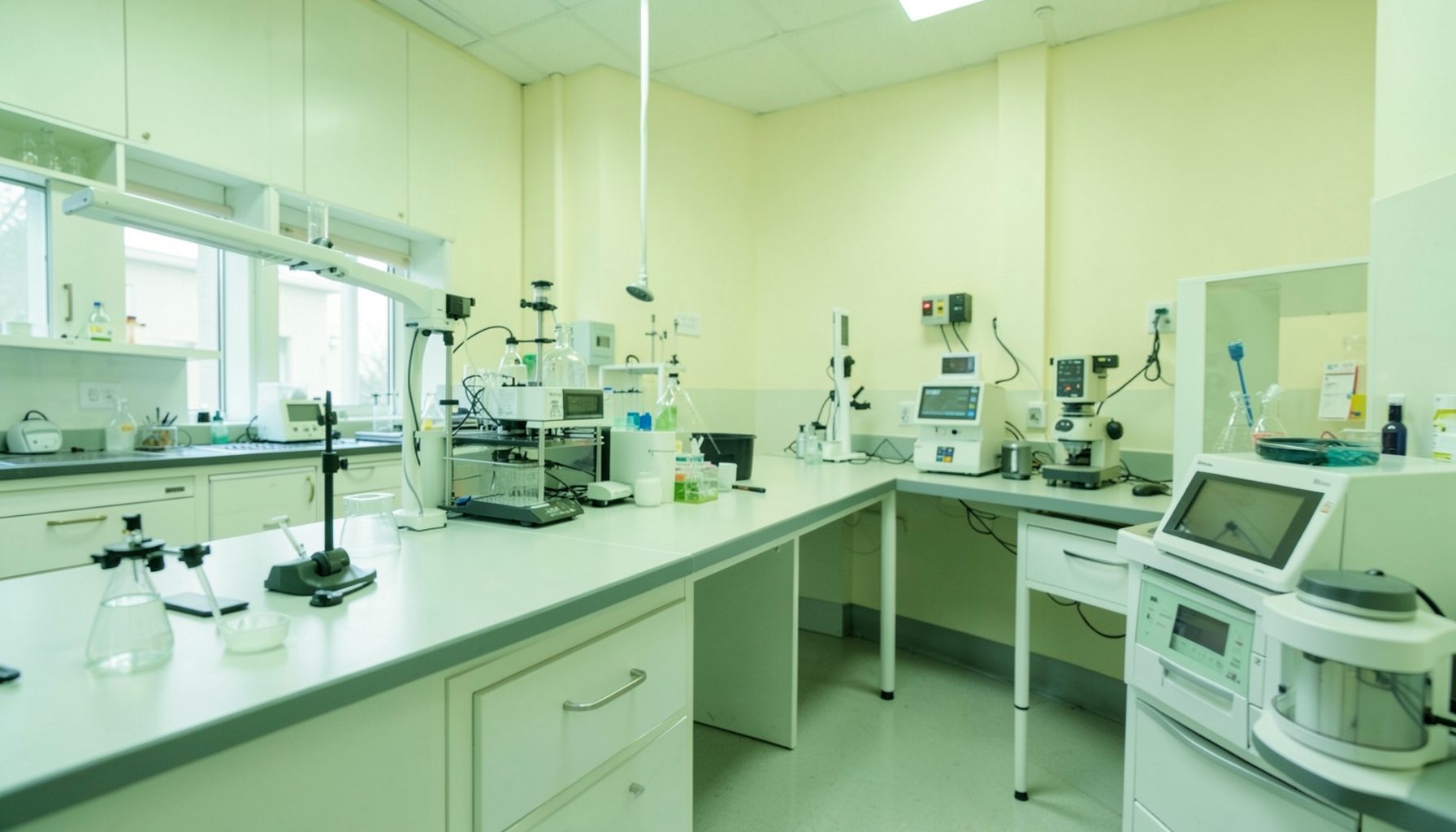
Designing a TB lab environmental monitoring plan for air and surfaces
Australia records one of the lowest tuberculosis incidence rates in the world, yet every jurisdiction still classifies TB as a notifiable disease. Active transmission occasionally surfaces in remote Indigenous communities and in urban centres with high migrant populations, which keeps diagnostic and reference laboratories in Sydney, Melbourne, Brisbane, Perth, Adelaide, Hobart and Darwin continuously engaged with mycobacterial work.
Laboratories performing culture, identification and drug susceptibility testing expose staff to infectious aerosols generated during specimen processing, smear preparation and liquid culture handling. An environmental monitoring plan provides the systematic checks that detect containment breaches before they translate into laboratory-acquired infection or specimen cross-contamination. The plan sits within a broader quality system, alongside biosafety, equipment maintenance and internal audit programmes that Australian laboratories routinely align with NATA accreditation and AS/NZS standards for microbiological safety cabinets.
A robust plan describes what gets sampled, where, how often, with which method, and how results are interpreted and acted upon. It must cover both airborne and settled contamination, since droplet nuclei behave very differently once they leave a centrifuge or biological safety cabinet. The plan should also recognise that Australian laboratories operate across dramatically different climates, from the humid tropics of far north Queensland to the temperate conditions of a Melbourne winter, each stressing ventilation systems in its own way.
The GLI Quality Tool provides a structured four-phase roadmap for laboratories building or strengthening their quality systems. Its framework translates neatly to environmental monitoring, and the platform offers phase-specific checklists for planning, implementation and continual improvement.
Defining scope, objectives and target organisms
Before sampling begins, the laboratory must articulate the purpose of the programme. Is the goal to verify biological safety cabinet integrity, confirm that laboratory air remains free of cultivable mycobacteria, or demonstrate that work surfaces stay clean enough to prevent cross-contamination? Most Australian reference laboratories define a combined objective: protect staff, protect samples, and produce defensible evidence for accreditation bodies.
Scope follows from purpose. Laboratories working exclusively with solid media face a different risk profile than those handling large-volume liquid cultures in MGIT systems, where aerosols are generated at bottle cap removal, inoculation and disposal. Mapping the laboratory by activity rather than by room number focuses resources where they matter most. Targets include M. tuberculosis, non-tuberculous mycobacteria that signal environmental contamination, and indicator organisms that suggest general hygiene failure, with reference laboratories in Sydney and Melbourne typically including a panel of indicator bacteria to speed interpretation.
Air sampling strategies for TB laboratories
Air sampling relies on either active or passive methods. Active sampling pulls a defined volume through a sieve impactor such as an Anderson six-stage sampler or a MAS-100 device onto a culture plate, producing quantitative colony-forming-unit results per cubic metre. Passive sampling uses gravity settle plates left open for a set period, which integrates contamination over time but yields only semi-quantitative data. Most Australian laboratories use active sampling as the primary method and reserve settle plates for sentinel locations.
Biological safety cabinets require their own programme, separate from room air monitoring. Australian laboratories typically certify cabinets to the AS 2252 series with on-site testing by NATA-accredited engineers at installation and annually thereafter. Between formal certifications, staff can verify airflow with anemometers and confirm HEPA filter integrity through particle counts and pressure gauges. Sampling should occur under realistic working conditions, such as running the cabinet and vortexing a positive control, rather than at the start of the day when the laboratory is still quiet.
Surface sampling methods for benches and equipment
Surface sampling relies on contact plates, swabs or ATP bioluminescence assays. Contact plates press directly against the work surface and pick up organisms that grow on the chosen medium, while swabs sample smaller or irregularly shaped areas such as equipment handles, centrifuge keypads and door pulls. ATP assays give a rapid proxy for organic contamination and are useful for routine cleaning verification, although they do not distinguish mycobacteria from other organisms.
Medium selection shapes what the results mean. Standard nutrient agar reveals general contamination, while selective mycobacterial media such as Middlebrook 7H10 or 7H11 reveal only organisms growing under mycobacterial conditions. Reference laboratories in Brisbane and Perth often add a fungal plate, given humid conditions that favour mould growth. High-touch surfaces deserve closer attention than floors and walls, and tracking staff movement for a week produces a far more useful sampling map than any generic template.
Frequency, scheduling and seasonal considerations
Risk determines frequency rather than a fixed calendar. Newly commissioned laboratories sample intensively during validation, often weekly, before settling into monthly or quarterly checks. Sites that have just experienced construction work, equipment replacement or a contamination event should temporarily return to a more intensive schedule until control is re-established.
Seasonality affects Australian laboratories in ways that are easy to overlook. In Darwin and Cairns, the monsoon drives humidity above eighty percent for weeks, stressing HVAC systems and encouraging microbial growth inside ductwork. In Melbourne and Hobart, winter brings a different pressure when doors stay closed and outside-air ratios fall. Recording the season alongside each sampling event reveals patterns a flat calendar never will, and an annual review of the sampling map alongside incident logs keeps the programme honest.
Documentation, corrective actions and continual improvement
Sampling without action is wasted effort. Each result should be recorded on a controlled form with date, location, method, media, lot numbers, operator and incubation conditions, then plotted over time rather than read in isolation. A sudden rise in surface counts at a single bench may trace to a leaking tube rack, while a slow drift in cabinet airflow often reflects a filter approaching the end of its service life.
The phase four resources of the GLI framework guide laboratories through assessment, corrective action and continual improvement, which is where most monitoring programmes either mature or quietly fail. Action thresholds belong in the laboratory quality manual, with explicit responsibilities for who investigates, who decides on closure and how findings feed into management review. External assessors expect evidence that monitoring drives change, so internal audit reports should cite results, training records should follow up on identified gaps, and equipment service logs should close out every issue.
Tailoring the plan to Australian resource settings
Australian laboratories span a wide resource spectrum. Centralised reference facilities in capital cities operate with dedicated biosafety officers, on-site engineers and ready access to NATA-accredited service providers. Regional and remote laboratories, including those serving Indigenous communities across the Northern Territory and northern Western Australia, often run with smaller teams and rely on visiting engineers or fly-in service contracts. A plan that copies a metropolitan template verbatim will collapse under that load.
For smaller laboratories the practical move is to prioritise the highest-risk activities rather than spread effort too thinly. Twice-yearly active air sampling in the culture room, monthly surface contact plates at defined sentinel points, and annual cabinet certification by a NATA-accredited provider usually meet biosafety expectations without overloading staff. The checklists available through the GLI Quality Tool help match monitoring intensity to the laboratory's current phase. State reference laboratories such as the Institute of Clinical Pathology and Medical Research in Sydney, the Victorian Infectious Diseases Reference Laboratory and the Queensland Mycobacterium Reference Laboratory also provide confirmatory testing, training and method standardisation that smaller sites can draw on.
Comparing air and surface sampling approaches
| Method | Sample type | Quantitative result | Equipment cost | Time to result | Best fit |
|---|---|---|---|---|---|
| Anderson six-stage sampler | Active air | Yes (CFU per m³) | High | 1–4 weeks | Reference labs, cabinet validation |
| MAS-100 / SAS sampler | Active air | Yes (CFU per m³) | Moderate | 1–4 weeks | Routine room air monitoring |
| Settle plates | Passive air | Semi-quantitative | Low | 1–4 weeks | Sentinel locations, low-resource settings |
| Contact (RODAC) plates | Surface | Yes (CFU per plate) | Low | 1–4 weeks | Bench tops, inside cabinets |
| Swabs with broth enrichment | Surface | Semi-quantitative | Low | Days to weeks | Irregular surfaces, equipment panels |
| ATP bioluminescence | Surface | Relative light units | Moderate | Minutes | Cleaning verification, rapid feedback |
Recommendations for laboratories building the plan
- Start with a clear written objective that distinguishes staff protection from sample integrity and names the actions each result will trigger.
- Map the laboratory by activity, mark high-touch surfaces and pair each location with a defined sampling method and frequency.
- Combine general and mycobacterial-specific media on every round to interpret results quickly and accurately.
- Schedule biological safety cabinet certification to AS 2252 with a NATA-accredited provider and record informal airflow checks between certifications.
- Review sampling data quarterly, link findings to corrective actions and bring the trend analysis into management review so the programme keeps evolving.
Laboratories that take time to write their environmental monitoring plan once and refine it through use find the document becomes a quiet anchor for daily practice. The GLI Quality Tool offers a ready-made structure for laboratories at any stage of this journey, and pairing its guidance with Australian knowledge of climate, geography and accreditation expectations gives any TB laboratory a solid foundation for safer, more reliable work.